
Introduction
Infertility issues can sometimes mean much more than an ailment; instead, they tend to take on a whole emotional meaning, especially when questions remain unanswered despite the results of various tests being normal. At such a time, laparoscopy for infertility becomes necessary.
With laparoscopy, specialists get to see directly and clearly all the reproductive parts – from the uterus to the fallopian tubes and beyond – that could be causing your infertility issue. Not only that but in many situations, your infertility condition may be solved immediately upon finding what the issue was.
Over the years, fertility management practices have developed and changed, and laparoscopy plays a vital part in making it possible for people to conceive easily. Laparoscopy is less intrusive and offers faster recovery, reduced pain, and high precision than any other technique used before.
What Is Laparoscopy for Infertility?
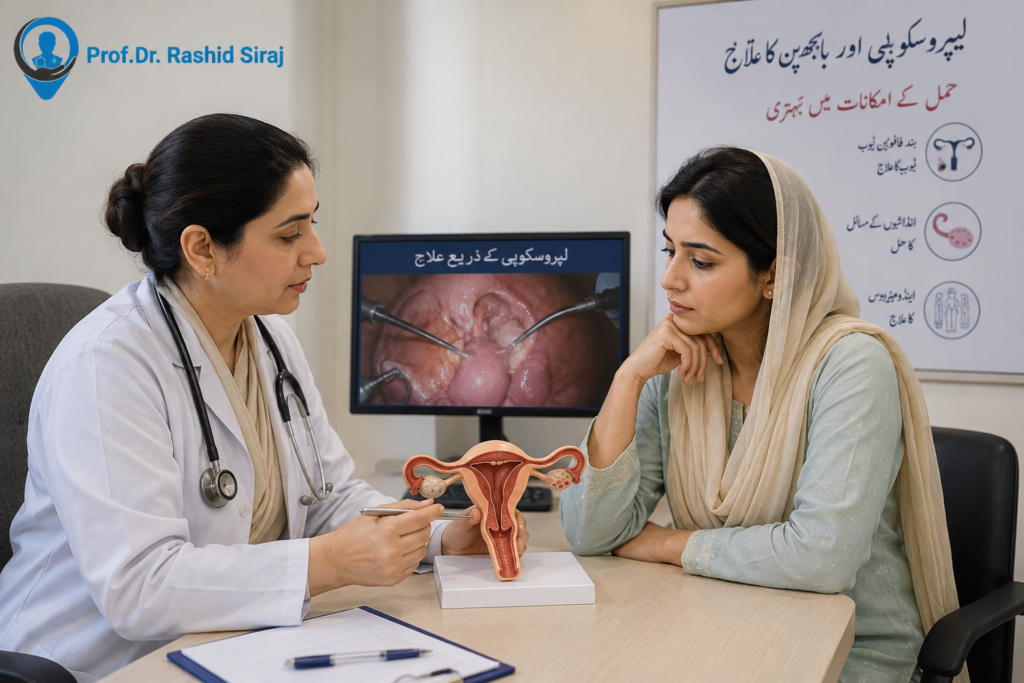
Laparoscopy is a minimally invasive surgical procedure that allows doctors to examine the female reproductive system from the inside.
During the procedure, a surgeon inserts a thin, lighted camera called a laparoscope through a small incision in the abdomen. This gives a real-time, detailed view of the pelvic organs that no external scan can replicate.
What makes it so valuable in fertility care is that it can detect conditions that simply don’t show up on routine tests. And if something abnormal is found, it can very often be treated immediately during that same surgery and no second procedure needed.
Conditions That Can Affect Pregnancy
Several reproductive conditions can quietly interfere with conception without causing obvious symptoms or showing up clearly on standard tests. Laparoscopy can both identify and, in many cases, treat these conditions directly:
- Endometriosis — Abnormal tissue growth that damages reproductive organs and significantly reduces fertility. It’s more common than many people realise, and often goes undetected for years.
- Blocked Fallopian Tubes — When the tubes are blocked, eggs and sperm simply can’t meet. Laparoscopy can identify the blockage and, depending on the cause, help restore normal function.
- Ovarian Cysts — Certain cysts interfere with ovulation. Removing them laparoscopically can help the ovaries work as they should.
- Pelvic Adhesions — Internal scar tissue from past infections or surgeries can bind pelvic organs together, restricting their movement and affecting fertility in subtle but meaningful ways.
- Fibroids — Depending on their size and location, fibroids may interfere with implantation. Laparoscopy can help assess their impact.
- Unexplained Infertility — Perhaps the most important use of all. When everything else comes back normal but pregnancy isn’t happening, laparoscopy is often where the real answer is finally found.
This is why laparoscopy for infertility is considered one of the most valuable tools in modern fertility evaluation.
Laparoscopy Improves Pregnancy Chances
Laparoscopy doesn’t just tell you what’s wrong, it actively improves the conditions for conception. Here’s how:
Removal of Endometriosis
Endometriosis tissue that is damaging the reproductive organs can be carefully removed during the procedure, reducing inflammation and restoring healthier conditions for conception.
Opening Blocked Fallopian Tubes
By treating tubal blockages directly, the procedure can restore the normal pathway that allows an egg and sperm to meet, giving natural conception a real chance again.
Treatment of Ovarian Cysts
Cysts that are disrupting ovulation can be safely removed laparoscopically, allowing the ovaries to resume their normal cycle.
Removal of Pelvic Scar Tissue
Adhesions that are restricting organ movement and function can be carefully released, freeing the reproductive organs to work properly.
Better Fertility Planning
Even when treatment isn’t performed, the findings from laparoscopy give your fertility team a much clearer, more honest picture. Whether the next step is natural conception, medication, IUI, or IVF, the decision is now based on real information, not guesswork.
Symptoms for Fertility Laparoscopy
In some cases, there are signs indicating a possible reproductive problem despite the results being inconclusive from initial testing.
Common Symptoms:
- Chronic pelvic pain that doesn’t have a clear explanation
- Painful periods that feel disproportionately severe
- Irregular menstrual cycles
- Pain during intercourse
- A history of pelvic infections
- Difficulty conceiving after one year of trying (or six months if you’re over 35)
If any of this seems relevant to you, then it might be a good idea to discuss the potential benefits of further investigation through procedures such as laparoscopy with your fertility doctor.
Advantages of Laparoscopic Fertility Treatment
1. Small Incisions
Since small incisions leave almost no scars at all, the recovery process becomes quicker and much more pleasant when compared to an open operation.
2. Fast Recovery
On average, people recover from the surgery in about one or two weeks, though it might be even quicker.
3. Minor Pain After Surgery
Due to the fact that the intervention affects fewer tissues, the post-operation pain becomes almost nonexistent.
4. Correct Diagnosis
No examination technique can give more accurate results than looking right at the organ’s condition.
5. Combined Procedure
Being able to both diagnose the issue and treat it on the spot allows you to save lots of time and feel better almost immediately.
How the Procedure Is Performed
Step 1: Anesthesia
Prior to starting the procedure, general anesthesia will be used, ensuring your complete comfort during the entire process.
Step 2: Making Small Cuts
These cuts will be made at the abdomen area near the navel.
Step 3: Inserting the Camera
This is inserted into the body, allowing the doctor a better view of the pelvic organs displayed on the monitor screen.
Step 4: Examining the Pelvic Area
Here, the uterus, ovaries, fallopian tubes, and surrounding tissues are checked for abnormalities that may affect fertility.
Step 5: Treatment
In case there are any anomalies such as endometriosis, cysts, adhesions, or obstructions, they can be treated on the spot through this procedure.
Step 6: Post-operation
At the end of the operation, the small cuts will be closed, after which you will be taken to the recovery room.
Recovery After Laparoscopy
Recovery after laparoscopic surgery is generally smooth, and most people are pleasantly surprised by how manageable it is.
First 24 Hours: Expect some mild abdominal discomfort, a little bloating, and fatigue from the anesthesia. This is completely normal and usually eases quickly with rest.
First Week: Light exercises are okay – in fact, exercise is recommended. Just make sure you look after the wounds and avoid lifting anything too heavy, but for the most part, normal activities won’t be difficult to do.
Full Recovery: Most patients recover completely within one to two weeks. The timeline can vary depending on whether treatment was performed during the procedure, so your surgeon will give you specific guidance based on your case.
Risks and Safety Considerations
Laparoscopy is a proven and safe technique; however, as any surgical operation done by the best surgeon, it carries certain risk factors that you should be aware of.
Possible Risks:
- Minor bleeding at the incision sites
- Risk of infection
- Temporary pain or discomfort
- Reaction to anesthesia
- In rare cases, inadvertent injury to nearby organs
It is crucial to keep the following information into consideration: complications during laparoscopic procedures are quite rare, especially in cases where a patient undergoes this examination in the right setting, under the supervision of a trained laparoscopic surgeon.
Who Should Consider Laparoscopy for Infertility?
Laparoscopy isn’t recommended for everyone, but it becomes an important option when certain signs point to a deeper problem. Your doctor may suggest it if you have:
- Unexplained infertility with no clear cause found through standard testing
- Suspected or confirmed endometriosis
- Possible blocked fallopian tubes
- Chronic pelvic pain
- Failed fertility treatments despite appropriate medication or procedures
- Abnormal results from other fertility investigations
A thorough fertility assessment is the starting point, your specialist will help determine whether laparoscopy is the right next step for you.
Choosing Experienced Fertility Surgeon
The outcome of any laparoscopic procedure depends enormously on who is performing it. Surgical skill, experience, and the ability to both identify and treat what’s found, all of this makes a real difference.
An experienced fertility surgeon helps ensure:
- A safe procedure with minimised risk
- Accurate diagnosis, not missed findings
- Effective treatment when it’s needed
- Fewer complications during and after surgery
- Better overall outcomes for your fertility journey
This isn’t a procedure to approach without doing your research. Choosing the right specialist is as important as choosing the procedure itself.
Moving Forward with the Right Fertility Care
Infertility surgery through laparoscopy has provided relief to thousands of women who were confused about the cause of their inability to conceive after months or even years of testing and trying without results. It helps achieve a diagnosis and treatment all at once through minimally invasive surgical techniques, providing answers and solutions to the mystery of infertility.
If you are among those having a tough time conceiving and cannot explain why or suffer from symptoms of an undiagnosed problem, perhaps it is time to consider a consultation for laparoscopic evaluation to understand better what you are dealing with regarding fertility issues.
For further information on the issue of infertility and how it can be diagnosed and treated successfully through laparoscopy, contact Prof. Dr. Rashid Siraj.