
How is a liver tumour diagnosed? A Complete Guide to Medical Tests
An odd finding on a liver scan can be quite the worrying thing. You’ll probably be asking yourself “is that cancer?” and what the next steps are. The doctor will look at your full medical history, your examination, the scans and the bloods to get a sense of what the lesion is.
Some liver tumours are completely asymptomatic and are picked up by accident. Others are investigated following abdominal pain, a feeling of fullness, loss of appetite or unexplained weight loss. A lump doesn’t necessarily mean cancer, some are benign and some are malignant.
What happens at the first appointment?
The doctor will take a full history of your symptoms and medical history (hepatitis B or C, cirrhosis, any previous liver problems, any abnormal scan results etc). They’ll do an abdominal exam and will look at any previous reports.
This history is the guide to the assessment but will not prove a tumour is present. The symptoms can have a number of different aetiologies and some people with a liver tumour will be perfectly well.
- Ultrasound: Often the First Scan
An abdominal ultrasound uses sound waves to produce images of the liver. It’s generally painless, involves no radiation and can be done fairly quickly.
The scan may show a lump, a cyst, liver changes or fluid. An abnormal area would probably require a more detailed scan.
Ultrasound can pick up an abnormality but doesn’t necessarily tell you whether that abnormality is benign or malignant. Further investigation may be required.
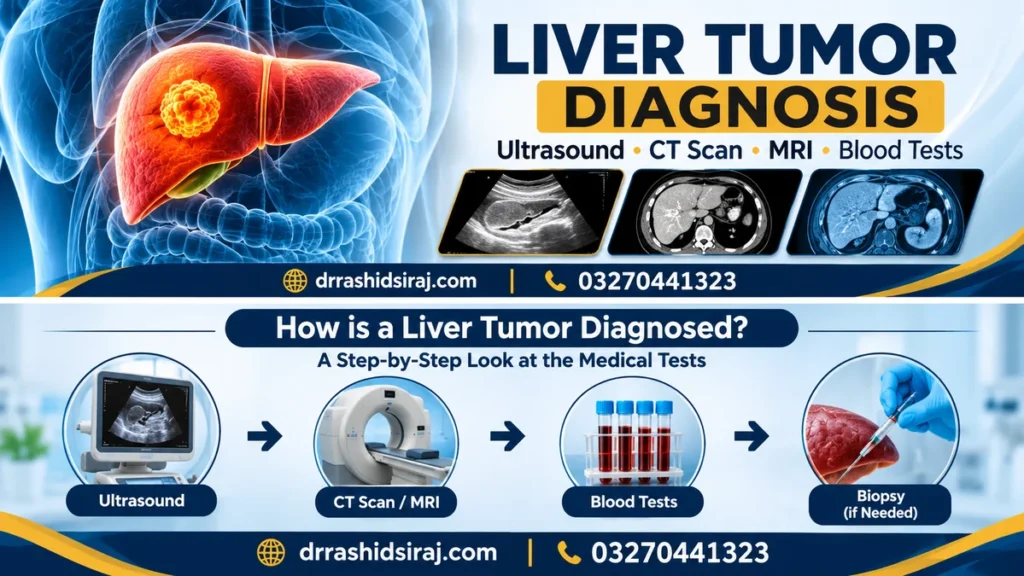
- CT Scan: A Closer Look at the Liver
A CT scan (computed tomography scan) takes a series of detailed images from different angles. For the assessment of the liver, contrast dye is typically injected into a vein. This allows the doctor to see the flow of blood and how the lesion appears at various stages of the scan.
A CT scan will show the size, position and appearance of the lesion and can also look at the adjacent blood vessels and organs. Certain patterns may be suggestive of hepatocellular carcinoma (HCC), the most common primary liver cancer.
Doctors will interpret the scan in conjunction with your full medical history and all the other results.
- MRI: Detailed Images When More Information Is Needed
MRI uses a magnetic field and radio waves to produce the images. It doesn’t use the same type of radiation as a CT scan.
An MRI may be indicated if the earlier scans haven’t quite answered all the questions. It can describe a lesion and is of some use in distinguishing between some benign lesions and some that are more suspect. A contrast agent may be used.
Both scans are useful. Which one you have will depend on your individual circumstances (your health, what previous scans have shown etc) and the clinical question at hand.
- AFP Blood Test: Helpful, But Not a Diagnosis
The alpha-fetoprotein test (often referred to as AFP) measures a protein in the blood. AFP levels can be elevated in some patients with hepatocellular carcinoma and so it may be requested as part of the investigation of a suspected liver tumour or in the follow up of patients at high risk.
AFP cannot be confirmed or ruled out as cancer. Some people with liver cancer have normal AFP levels and some other liver conditions will give rise to raised levels. The result is interpreted by the doctors in the context of the scans and other findings.
- Liver Biopsy: Examining a Tissue Sample
A liver biopsy involves taking a small tissue sample which is then examined under the microscope. A pathologist looks at the cells to help establish the nature of the growth.
A biopsy may be indicated if the scans are not entirely clear or if the type of tumour is going to have an impact on the treatment. A fine needle is usually guided by ultrasound or CT.
Not every patient needs a biopsy. In some patients with cirrhosis or other risk factors, characteristic imaging may be sufficient to make the diagnosis of HCC. The management team will decide whether or not to proceed with tissue sampling.
Why an Accurate Diagnosis Matters
Doctors will assess the likely type, size and location of the growth, whether it’s involving any of the adjacent structures and whether it’s spread. They’ll also look at the function of the remainder of the liver.
The findings will inform the discussion around care. The treatment options will vary depending on the diagnosis and the patient’s overall health and may include surgery, transplantation, ablation or other cancer therapies. Treatment is individual.
Where can patients in Pakistan go for advice?
If the scan report identifies a liver lesion then you need to arrange an assessment with a doctor who is suitably qualified. The liver specialist will be able to look at it and advise whether further tests are required.
- Dr Rashid Siraj is our contact for patients who have queries relating to the liver and surgical conditions.
Website: https://drrashidsiraj.com
Contact: 03270441323
Bring your previous ultrasound reports, any CT or MRI scans, your blood results, a full list of your medications and any other relevant records. This will help the doctor to see what has already been looked at.
Frequently Asked Questions
Can an ultrasound detect a liver tumour?
Yes, ultrasound can show an oddity in the liver. A CT or MRI would be required to look at it in more detail.
Is every liver tumour cancerous?
No, some of the liver lesions are benign (i.e. not cancerous) and some are malignant. Further assessment is required to determine the nature of the lesions.
Can a blood test confirm liver cancer?
There is no single blood test which can confirm or rule out liver cancer. AFP may be of some assistance in the assessment but must be considered in the context of the scans and other findings.
Is a liver biopsy always necessary?
No, some tumours can be diagnosed on the basis of characteristic imaging in the right clinical context. A biopsy will be performed if further information is required.
Is CT or MRI better?
Both are useful in their own right. The doctor will pick one or the other depending on the condition they suspect, the previous results and the patient’s overall health.
A Final Word
Liver tumour diagnosis is not based on a single result. It’s a combination of your history, the scans and the blood tests and sometimes a biopsy. If a report gives you any concern at all then don’t jump to any conclusions or interpret it yourself. Get a proper doctor to explain what it means and what should be done.