
Thyroid Surgery in Lahore: What Patients Should Know Before Treatment
If you’ve got a lump in your neck or difficulty swallowing you may be asking yourself whether treatment is in fact required. You may also be uncertain as to whether medication or thyroid surgery in Lahore is the right option for you. Getting a good understanding of thyroid surgery in Lahore will go some way to helping you to understand the available treatment options and will help you to be better prepared for your discussion with your surgeon.
Whilst there are a lot of people in Pakistan with thyroid problems, not all of them will need surgery. It will depend on the diagnosis, the size of the gland, the results of the investigations and the patient’s general state of health as to whether surgery is required.
Understanding what thyroid surgery is all about and what to expect in the recovery process can go a long way to helping you make an informed decision about your treatment.
What is Thyroid Surgery?
Thyroid surgery is the removal of part or all of the thyroid. The thyroid is a small butterfly-shaped gland in the front of the neck and produces hormones which regulate a number of fundamental body functions (metabolic rate, body temperature, heart rate etc).
Thyroid surgery may be indicated if other forms of treatment are inadequate in the management of a thyroid condition or if there is a concern about cancer.
Surgery may be required for:
- Large goitre
- Nodules causing pressure and/or symptoms
- Suspicious or confirmed cancer
- Specific hyperthyroid states
- Enlarged thyroid causing difficulty in breathing or swallowing
Whether you need surgery will be decided upon the basis of your physical examination and investigations.
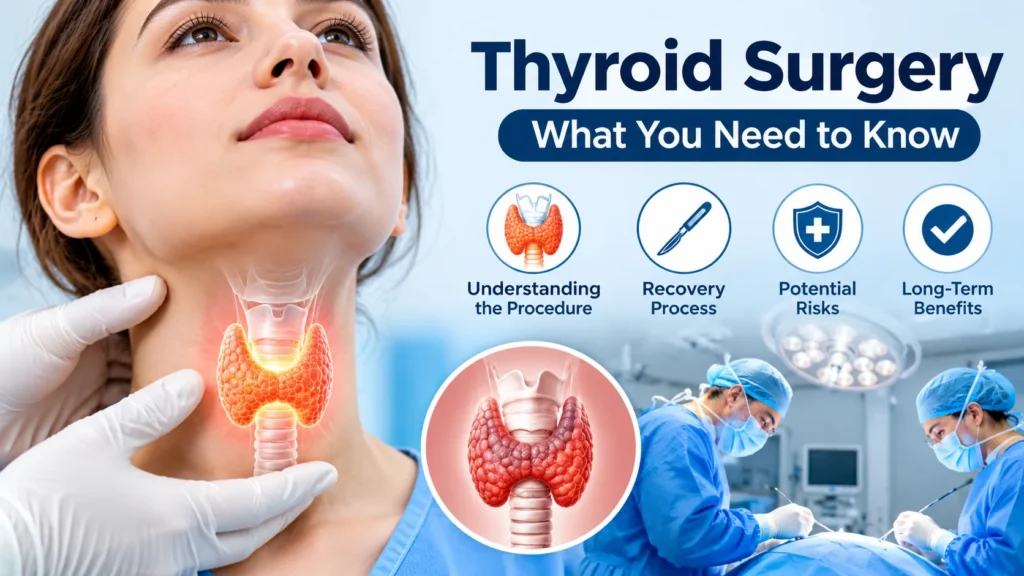
When is thyroid surgery required?
Thyroid surgery is only required in very specific circumstances. It is not a routine procedure and is generally only indicated when there is a need to remove a large thyroid nodule, or when there is a significant goitre.
Not all lumps in the thyroid or abnormal investigations mean you need surgery. A benign nodule may well just be monitored.
However, thyroid surgery may be recommended in the following cases:
Large Goitre
A very enlarged thyroid will cause a swollen neck, difficulty in swallowing and pressure on the windpipe.
Suspicious Nodules
If the nodules have come back as suspicious on ultrasound or biopsy then further investigation may be warranted. Depending on the findings and the clinical picture, surgery may be indicated.
Cancer
Thyroid cancer will often need surgery and the type of surgery required will depend on the nature and stage of the cancer.
Hyperthyroidism
In some cases with an overactive thyroid surgery can be of benefit. It may be the route of choice if other forms of treatment aren’t appropriate or have failed.
Types of Thyroid Surgery
Depending on the individual case and how much thyroid tissue needs to be removed, various types of surgery may be carried out.
Total Thyroidectomy
This is a total thyroidectomy. It can be indicated in certain cases of thyroid cancer, large goitres and other thyroid disorders.
People having a total thyroidectomy will need to be on lifelong replacement hormone therapy.
Partial Thyroidectomy
Part of the thyroid is removed.
Hormones may still be produced in sufficient quantities by the remaining thyroid tissue. Some people will still need to be on medication and will still need to be monitored.
Hemithyroidectomy/Thyroid Lobectomy
One lobe of the thyroid is removed. It may be appropriate in some cases of nodules or pathology confined to one lobe.
The appropriate surgery will be discussed with you by your surgeon.
How is thyroid surgery performed?
Generally the thyroid surgery is done under general anaesthetic.
The surgery may involve:
- Administration of general anaesthetic.
- An incision is made in the lower front of the neck.
- The affected lobe or the whole thyroid gland is removed.
- During the procedure care will be taken to avoid injury to the important structures (the nerves which are responsible for vocal function and the parathyroid glands).
- The incision is then closed. You’ll be monitored right through your recovery.
The duration of the procedure will vary from case to case.
Benefits of Thyroid Surgery
Thyroid surgery can be of benefit to the right patients.
Benefits may include:
- Removal of suspicious or malignant tissue.
- Reduces pressure from an enlarged thyroid gland.
- Eases the symptoms of difficulty swallowing and difficulty breathing due to a goitre.
- For specific conditions where other forms of treatment have failed.
- Enables a detailed analysis of the tissue to aid in the establishment of a diagnosis.
The benefits will vary from person to person. It cannot be guaranteed that all the symptoms associated with the thyroid condition will be sorted out.
Risks and Complications of Thyroid Surgery
As with any surgery, thyroid surgery will have risks. Your surgeon should be able to advise you as to what those risks may be.
Potential risks may include:
- Changes in voice function (either temporary or permanent).
- Bleeding and bruising.
- Infection.
- Low calcium levels due to either temporary or permanent dysfunction of the parathyroid glands.
- Requirement for lifelong thyroid hormone replacement.
Serious complications are rare. The right medical assessment and subsequent management are obviously essential though.
Recovery After Thyroid Surgery
Recovery times will be different for everyone. Many people will be able to go back to light duties fairly quickly following surgery, depending on the procedure and their general health.
Following Surgery
Short-term (first few days):
You may experience some neck discomfort, throat irritation or altered vocal function. Please adhere to your surgeon’s advice with regard to medication and wound care.
Medium-term (first 1-2 weeks):
As you’re recovering you may be able to ramp up your activity levels. Just don’t go over the top until you’ve been cleared to do so by your surgeon.
Longer-term:
Your doctor may well advise you to have blood tests to monitor your thyroid hormone levels and your calcium levels.
Living Without a Thyroid
Those having a total thyroidectomy will invariably require lifelong thyroid hormone replacement. Those having a partial thyroidectomy may or may not require medication depending on how much thyroid tissue is left.
Regular follow-up can be used to monitor hormone levels and to allow the medication to be adjusted as necessary.
Cost of Thyroid Surgery in Pakistan
The cost of thyroid surgery in Pakistan will depend on various factors:
- Type of procedure.
- Facilities and entry requirements at the hospital.
- Surgeon’s fee and anaesthetic.
- Investigations.
- Care and medication post op.
To get a proper estimate, you’ll need to talk to the hospital or surgical team regarding your diagnosis and treatment.
Thyroid Surgery in Lahore with Prof. Dr. Rashid Siraj
It’s absolutely vital to have an experienced surgeon. A careful assessment will establish whether surgery is in fact required and what procedure may be the most appropriate.
Prof Dr Rashid Siraj (General and Laparoscopic Surgeon) can provide advice and support in relation to surgical conditions.
If you have a thyroid lump, goitre, suspicious nodules or have been advised that you may need thyroid surgery in Lahore then please book an appointment so that we can go over your reports and treatment.
Frequently Asked Questions (FAQs)
Is thyroid surgery deemed to be major surgery?
Thyroid surgery is specialist surgery, carried out under general anaesthetic. How complex it is will of course vary from patient to patient.
How long is recovery after thyroid surgery?
Recovery time will be very much individual. A lot of people will be able to do very light duties within a couple of days. Full recovery may take a lot longer.
Can I live a normal life after having my thyroid removed?
Lots of people can go on to live perfectly normal lives after having their thyroid removed. Anyone having a total thyroidectomy will of course require lifelong thyroid hormone replacement and regular monitoring.
Will I need surgery for every nodule in my thyroid?
No, many thyroid nodules are benign and can be monitored regularly. Surgery would be considered on the basis of the symptoms, the imaging, the biopsy and the overall clinical picture.
Will my voice be affected after thyroid surgery?
Changes in voice may be seen temporarily. Damage to the nerves controlling the voice is a known complication and can sometimes lead to persistent changes.