
Introduction
Direct and indirect inguinal hernia remains among the topics that are widely discussed when it comes to general surgery due to the fact that these types of hernias take place in the same body part (groin) yet happen through totally different pathways. Direct and indirect inguinal hernia must be well known to understand what the patient refers to when they experience certain symptoms such as groin swelling or pains during physical activities.
In a direct and indirect inguinal hernia, abdominal organs protrude through the abdominal muscles, which is very dangerous, especially for the patients who fail to identify the difference between them.
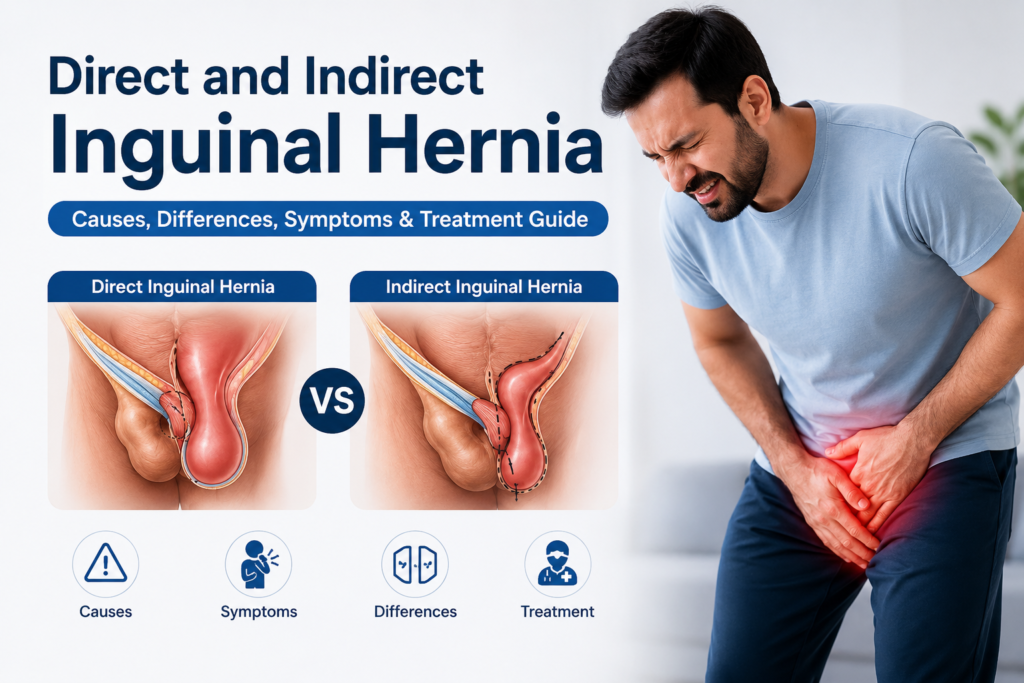
Direct VS Indirect Inguinal Hernia
| Feature | Direct Inguinal Hernia | Indirect Inguinal Hernia |
| Cause | Weak abdominal muscles | Congenital defect |
| Pathway | Pushes directly through abdominal wall | Enters via inguinal canal |
| Age Group | Mostly adults | Children & young adults |
| Onset | Develops over time | Present since birth |
| Risk Level | Moderate | Higher risk of complications |
| Common Side | Acquired hernia | Developmental hernia |
This comparison clearly explains the structural and developmental differences in direct and indirect inguinal hernia, making diagnosis easier for both patients and doctors.
Understanding Direct Inguinal Hernia
A direct inguinal hernia occurs when abdominal tissue pushes through a weakened area in the abdominal wall near the groin. This condition usually develops later in life due to muscle weakness.
Causes of Direct Hernia
Direct hernias are mainly caused by gradual weakening of abdominal muscles, increased abdominal pressure, obesity, heavy lifting, and chronic straining.
Who Is at Risk?
This type is commonly seen in older adults, especially males, due to natural muscle degeneration over time.
Key Features
- Develops slowly over time
- Rarely enters the scrotum
- Usually caused by lifestyle or aging factors
Understanding Indirect Inguinal Hernia
An indirect inguinal hernia occurs when abdominal contents pass through the inguinal canal due to a congenital opening that fails to close properly during fetal development.
Causes of Indirect Hernia
This condition is usually present from birth and becomes more noticeable later in life due to increased pressure or physical activity.
Who Is at Risk?
It commonly affects children and young adults and is more frequent in males due to natural anatomical structure.
Key Features
- Present since birth
- Can travel into the scrotum
- Higher risk of complications
Symptoms of Direct and Indirect Inguinal Hernia
Both types share similar symptoms, making clinical evaluation important for proper diagnosis.
Common Symptoms
- Visible bulge in groin area
- Pain or discomfort while lifting or bending
- Heavy or dragging sensation in the lower abdomen
- Burning or pressure in groin region
Severe Symptoms
- Sudden pain and swelling
- Nausea or vomiting
- Inability to push bulge back
- Signs of bowel obstruction
Causes and Risk Factors
The development of direct and indirect inguinal hernia depends on different internal and external factors.
Direct Hernia Causes:
- Aging: Direct hernias often develop due to natural weakening of abdominal muscles with increasing age.
- Obesity: Excess body weight increases pressure on the abdominal wall, leading to hernia formation.
- Chronic Coughing: Continuous coughing puts repeated stress on abdominal muscles, contributing to weakness.
- Repeated Strain: Frequent heavy lifting or straining during physical activity can damage abdominal muscle support over time.
Indirect Hernia Causes:
- Birth-related opening: Indirect hernias occur due to a congenital opening in the inguinal canal that fails to close after birth.
- Developmental defect: Improper formation of abdominal structures during fetal development can lead to weakness in the groin area.
- Increased pressure over time: Activities that increase abdominal pressure may cause the hernia to become more noticeable later in life.
- Genetic factors: A family history of hernias may increase the likelihood of developing an indirect inguinal hernia.
Common Risk Factors:
- Heavy lifting: Frequent lifting of heavy objects increases pressure on the abdominal wall and raises hernia risk.
- Chronic constipation: Straining during bowel movements puts continuous stress on abdominal muscles.
- Obesity: Excess body weight creates extra pressure on the groin and abdominal region.
- Family history: A genetic tendency can make some individuals more prone to developing hernias.
- Weak abdominal muscles: Naturally weak or damaged muscles reduce support and increase the chance of hernia formation.
Diagnosis of Inguinal Hernia
Doctors diagnose direct and indirect inguinal hernia through physical examination and medical imaging.
Physical Examination
Doctors check for bulging in the groin area while the patient coughs or strains.
Imaging Tests
Ultrasound or CT scans help confirm the type and severity of the hernia.
Medical Evaluation
Patient history, symptoms, and risk factors are also carefully reviewed before diagnosis.
Treatment Options for Hernia
Treatment depends on severity, symptoms, and risk of complications and should always be evaluated by a specialist surgeon for accurate diagnosis and appropriate management.
Surgical Repair
Surgery is the most effective treatment for both types. The hernia is pushed back, and the weak area is repaired using stitches or mesh.
Laparoscopic Surgery
This minimally invasive approach, known as laparoscopic surgery, uses small incisions and a camera, offering faster recovery and less postoperative pain.
Open Surgery
In complex cases, traditional surgery may be required to directly repair the abdominal wall defect.
Recovery After Hernia Surgery
Recovery after treatment of direct and indirect inguinal hernia is usually smooth with proper care.
Patients are advised to avoid heavy lifting, follow wound care instructions, maintain healthy weight, and attend follow-up visits. Most individuals recover within a few weeks depending on the surgical method used.
Complications if Left Untreated
Ignoring direct and indirect inguinal hernia can lead to serious health risks.
Hernia Enlargement: The bulge may increase over time, causing discomfort and difficulty in movement.
Incarceration: The hernia may become trapped and cannot return to its normal position.
Strangulation: Blood supply may be cut off, leading to tissue damage and emergency surgery.
Prevention and Lifestyle Management
While congenital indirect hernias cannot be prevented, direct hernias can be reduced with lifestyle changes.
Preventive Measures
- Maintain healthy body weight
- Avoid heavy lifting
- Strengthen abdominal muscles
- Treat chronic cough and constipation
- Avoid excessive strain during physical activity
These habits reduce abdominal pressure and lower the risk of developing a hernia.
Takeaway and Expert Consultation
Understanding direct and indirect inguinal hernia is essential for early diagnosis and proper treatment. While both conditions affect the groin area, they differ in cause, development, and risk level. Direct hernias develop due to muscle weakness over time, while indirect hernias are usually congenital.
With timely medical attention, modern surgical techniques, and proper care, patients with direct and indirect inguinal hernia can recover fully and return to normal life without complications.
If you notice groin pain, swelling, or a bulge that increases with activity, it is important not to ignore it. Consult a specialist surgeon for accurate diagnosis and personalized treatment to avoid future complications. For expert evaluation and advanced hernia care, book a consultation with Prof. Dr. Rashid Siraj for safe and effective treatment options.